
An annual general meeting (AGM), also called an annual business meeting or annual meeting of members, is the yearly meeting where an organization reports to its members or shareholders. The board presents the year’s results and accounts, members elect directors or officers, and important decisions are put to a vote. Because an AGM is usually required by the organization’s constitution or bylaws, it follows a formal agenda.
On this page you’ll find free AGM agenda templates in Microsoft Word, a sample annual general meeting agenda, the standard AGM order of business, agenda outlines for companies, nonprofits, clubs and churches, and a preparation timeline to help you plan.
Free AGM agenda templates
Templates for annual business meetings, annual general meetings and annual board meetings. Download them free and edit in Word or Google Docs.
Here are previews and download links of Free Sample Annual Business Meeting Agenda Templates created using MS Word,
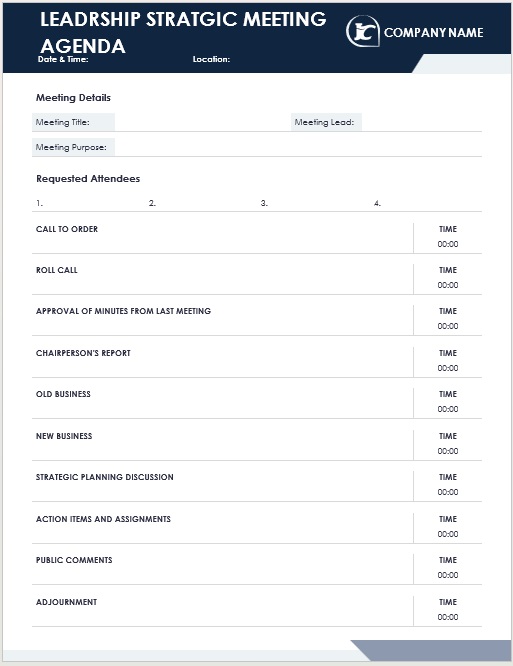
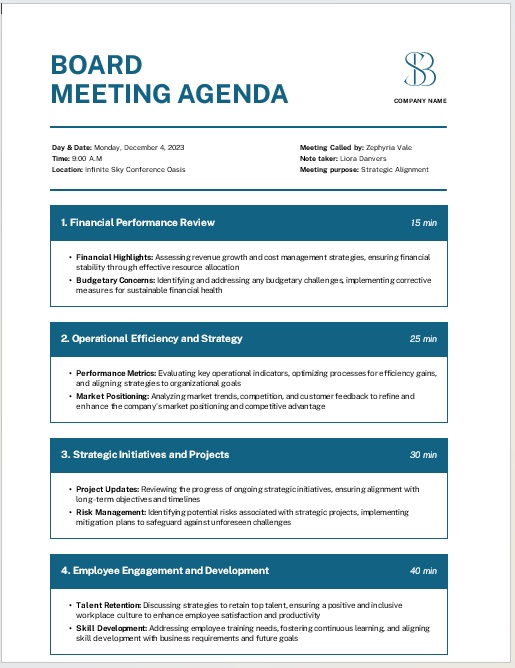
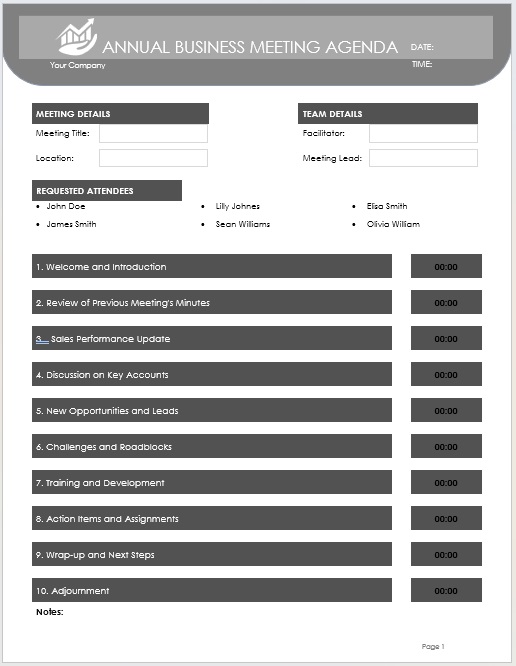
Annual Business Meeting Agenda Template
File Type: MS Word {Zip File}
File Size: 427 KB
Annual general meeting agenda example
Here is a sample AGM agenda for a members’ club. It follows the standard order of business: formalities first, then the annual reports and accounts, then elections and motions.
Westfield Tennis Club
Annual General Meeting Agenda
Key business: Elect the committee for the coming year
| Time | Item | Lead |
|---|---|---|
| 10:00 | Welcome, apologies and quorum | Chair |
| 10:05 | Minutes of the last AGM | Secretary |
| 10:10 | Matters arising | Chair |
| 10:15 | Chair’s annual report | Chair |
| 10:30 | Treasurer’s report and annual accounts | Treasurer |
| 10:45 | Appointment of the accounts examiner | Members |
| 10:50 | Election of officers and committee | Secretary |
| 11:10 | Motion: increase the annual membership fee | Members |
| 11:25 | Any other business and close | Chair |
Notice, agenda and nomination form sent to members 21 days before
Motions that need a vote, such as the fee increase, should be listed on the agenda and sent with the notice, so members can decide whether to attend or appoint a proxy.
Standard AGM order of business
Most annual general meetings follow this order. Your constitution or bylaws may add items or change the order.
- Welcome and apologies. The chair opens the meeting and records apologies from members who couldn’t attend.
- Notice and quorum. Confirm that the meeting was properly called and that enough members are present.
- Minutes of the previous AGM. Members approve the minutes as a correct record.
- Matters arising. Follow-up on actions from last year’s AGM that aren’t elsewhere on the agenda.
- Annual report. The chair or chief executive reports on the year’s activities and achievements.
- Financial report and accounts. The treasurer presents the annual accounts for approval.
- Appointment of auditors or examiners. Members appoint the auditor or independent examiner for the next year, where required.
- Elections. Election of directors, trustees, officers or committee members.
- Motions and resolutions. Votes on proposals, such as fee changes or amendments to the constitution.
- Any other business (AOB). Brief items for information. Many constitutions don’t allow binding decisions under AOB.
- Close. The chair thanks members and formally closes the meeting.
What is the purpose of an AGM?
An AGM holds the people running the organization accountable to its members. It gives members a regular chance to review performance and finances, question the board or committee, elect the people who will lead the organization, and vote on major decisions. For many companies, charities and associations, holding an AGM is also a legal or constitutional requirement.
AGM agendas for different organizations
Company or shareholder AGM
The annual meeting of a company’s shareholders.
- Opening and confirmation of quorum
- Chair’s and CEO’s address
- Presentation of the annual report and financial statements
- Election or re-election of directors
- Appointment of auditors and approval of their fees
- Approval of dividends, if proposed
- Other ordinary and special resolutions
- Shareholder questions
- Voting results and close
Nonprofit or charity AGM
- Welcome, apologies and quorum
- Minutes of the previous AGM
- Chair’s report on the year’s work and impact
- Treasurer’s report and annual accounts
- Appointment of the auditor or independent examiner
- Election of trustees or board members
- Resolutions, such as changes to the constitution
- Recognition of volunteers and supporters
- Any other business and close
Club, association or society AGM
- Welcome and apologies
- Minutes of the last AGM and matters arising
- Chair’s or president’s report
- Treasurer’s report and membership fees
- Reports from committees or sections
- Election of officers and committee
- Motions from members
- Awards and recognition
- Any other business and close
Church annual business meeting
- Opening prayer and welcome
- Confirmation of quorum
- Minutes of the last annual meeting
- Pastor’s report
- Ministry and committee reports
- Financial report and next year’s budget
- Election of officers, deacons or elders
- Other business and closing prayer
For homeowners associations, see our HOA annual meeting agenda. For the board’s own yearly meeting, see the annual board meeting outline on our board of directors meeting agenda page.
AGM notice, quorum and voting
Notice. Members must usually receive written notice of the AGM a set number of days in advance, often 14 or 21 days. The notice normally includes the date, time and place, the agenda, the text of any resolutions, a proxy form, and details of how to nominate candidates.
Quorum. The quorum is the minimum number of members who must attend for the meeting to make valid decisions. It is set in the constitution or bylaws. If there is no quorum, the meeting is usually adjourned to a later date.
Proxies and voting. Many organizations let members appoint a proxy to vote for them. Votes are usually taken by a show of hands, with a formal poll if requested. Some decisions, such as changes to the constitution, often need a larger majority, such as two-thirds or 75% of votes cast.
The rules differ by country, state and type of organization, and your own governing documents come first. Check your constitution or bylaws and any legal requirements that apply to you. This page is general information, not legal advice.
AGM preparation timeline
| When | What to do |
|---|---|
| 8 weeks before | Set the date, book the venue or online platform, check the notice rules in your constitution |
| 6 weeks before | Call for nominations and motions from members; ask for the accounts to be finalized |
| 3–4 weeks before | Send the formal notice, agenda, proxy forms and resolutions (or earlier if your rules require) |
| 1 week before | Finalize the annual report, accounts, ballot papers and sign-in sheet |
| On the day | Register attendees, check quorum and proxies, and appoint a minute-taker |
| 2–4 weeks after | Circulate draft minutes and file any required returns or updates |
Tips for running a smooth AGM
- Keep the formal business tight. Members attend for the reports, the elections and the key votes. Move quickly through the formalities.
- Send reports in advance. Circulating the annual report and accounts before the meeting leaves time for questions instead of long presentations.
- Prepare for elections. Have nomination forms, candidate statements and ballot papers ready, and agree who will count votes.
- Take accurate minutes. Record attendance, apologies, reports received, election results and the exact wording and outcome of every resolution. Our meeting minutes templates can help.
- Make it worth attending. Many organizations add a short talk, awards or refreshments after the formal business to encourage turnout.
Frequently asked questions
What is an AGM?
An AGM, or annual general meeting, is a yearly meeting of an organization’s members or shareholders. It is used to present the annual report and accounts, elect directors or officers, and vote on important decisions.
What should be on an AGM agenda?
A typical AGM agenda includes the welcome and apologies, notice and quorum, minutes of the previous AGM, matters arising, the annual report, the financial report and accounts, appointment of auditors, elections, motions and resolutions, any other business, and the close.
What is the difference between an AGM and a board meeting?
An AGM is a meeting of all members or shareholders, held once a year. A board meeting is a meeting of the directors only, held regularly throughout the year to run and oversee the organization.
Who can attend an AGM?
All members or shareholders are usually entitled to attend, speak and vote. Directors, officers, staff and auditors typically attend too. Some organizations also invite non-members as observers without voting rights.
How long does an AGM last?
Most AGMs for clubs, associations and small nonprofits take 60 to 90 minutes. Company AGMs vary widely, from under an hour to several hours for large public companies.
What does AOB mean on an AGM agenda?
AOB stands for any other business. It is a short item at the end of the meeting for topics not listed elsewhere. Many constitutions don’t allow binding decisions to be made under AOB, because members weren’t given notice of them.
Related meeting agenda templates
You may also need a board of directors meeting agenda, HOA meeting agenda, formal meeting agenda, community meeting agenda or meeting minutes templates. Or browse all meeting agenda templates.
Pingback: Executive Meeting Agenda Templates for Leadership Teams