
A conference brings together many speakers and attendees around a shared field or theme, usually over one or more days. Unlike a meeting or a single seminar, a conference runs several kinds of sessions: keynotes for everyone, breakout sessions in parallel tracks, panels, workshops, and plenty of time for networking. The conference agenda, often called the conference program, is how attendees plan their day and find the sessions that matter to them.
On this page you’ll find free conference agenda templates in Microsoft Word, a sample two-day conference program, the main types of conference sessions explained, tips for building a schedule that works, a planning timeline, and a simple conference call agenda.
Free conference agenda templates
Templates for conference programs, schedules, timelines and printable agendas. Download them free and edit in Word or Google Docs.
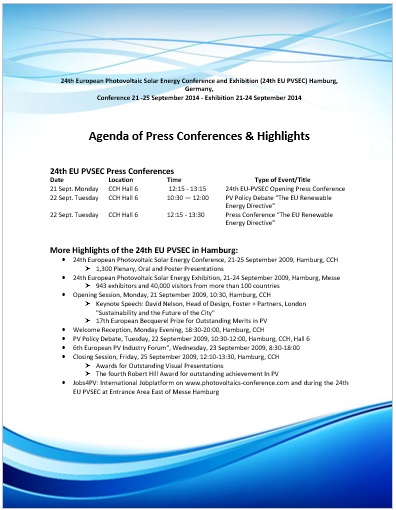
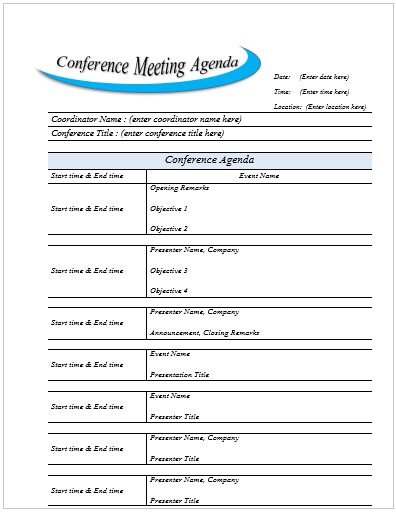
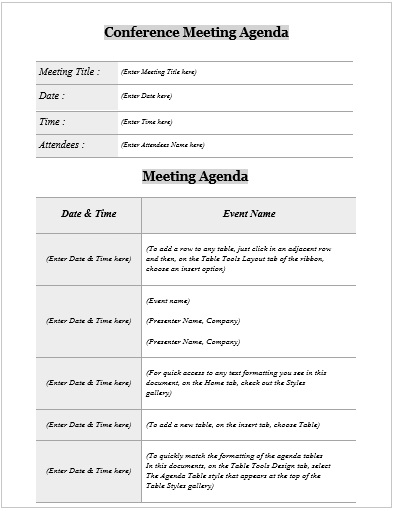
Editable Conference Meeting Agenda Template
File Type: MS Word {Zip File}
File Size: 15 KB
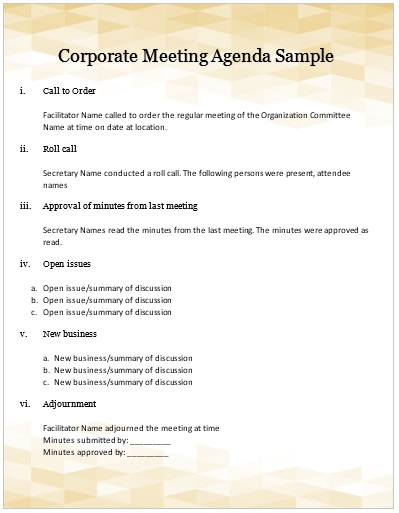
A conference is normally general in its execution as compared to a meeting, which is more formal and precise. Also, the feedback at the end of the conference is not as specific as it used to be in a meeting. However, the conference is always arranged with some purpose and the participants of the conference are given clear tasks during the arrangement of the conference. In order to get the desired results from a conference meeting, it should be properly arranged and managed.
The conference calls are generally conveyed to all the participants to make sure they active participation. Furthermore, the conference call agenda is conveyed to the participants so that they can prepare for the coming conference. The outcomes of the conference meeting mostly depend on how well the participants are communicated. Therefore, it is important to develop the conference meeting agendas on realistic and proper lines.
Busy with the office work and tangled with the pile of paperwork on your desk? No time for preparing for the meeting, even when it is going to be your first meeting. Do not worry; you can find certain standards laid off for the preparation and conduction of a meeting. These standards provide you general check points if followed will help you in the execution of a perfect meeting and save your valued time. There are various types of meetings that are held in the corporate world at different intervals. For example, formal meetings, informal meetings, monthly meetings, routine meetings, etc. A Conference Meeting is held where a group of people related to a certain subject assemble together to have a detailed analysis about issues.
The meetings prefaced by the term conference are usually location and agenda dedicated. First of all, the location you are selecting must be suitable to the agenda of the conference. Going by the standard methods, the agenda must be decided before selecting the location. Decide whether the problem is important enough to call for a conference because general meetings include a small number of members as compared to a conference meeting. People from different places come to attend the meeting and if the agenda is not paid proper attention, it may lead to a wastage of time and budget.
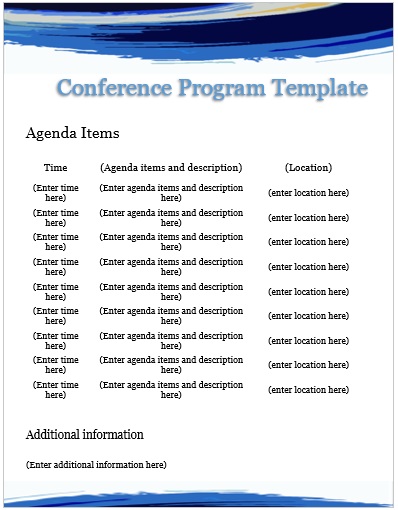
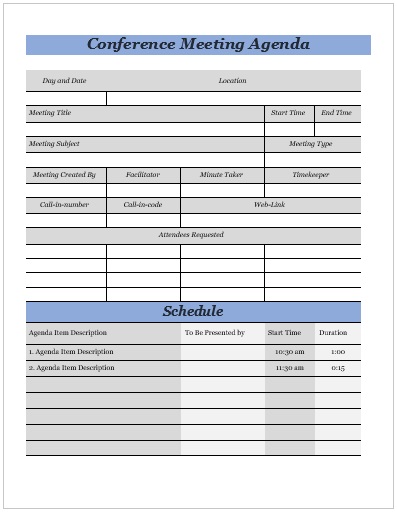
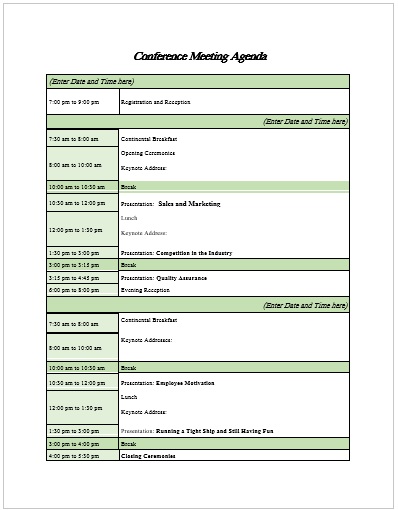
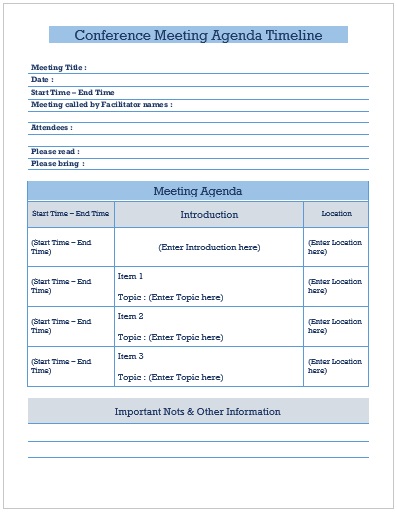
Conference agenda example
Regional Small Business Conference
Two days · Harbor Convention Center · 350 attendees · Three breakout tracks: Marketing (Room A), Finance (Room B), Technology (Room C)
| Time | Session | Location |
|---|---|---|
| Day 1: Growth | ||
| 8:00 AM | Registration, breakfast and exhibition | Main foyer |
| 9:00 AM | Welcome and opening remarks | Main hall |
| 9:20 AM | Keynote: What the next five years mean for small business | Main hall |
| 10:15 AM | Coffee break and exhibition | Main foyer |
| 10:45 AM | Breakout sessions: Local SEO basics · Cash-flow forecasting · Choosing business software | Rooms A, B, C |
| 12:00 PM | Lunch and networking | Dining hall |
| 1:15 PM | Panel: Hiring and keeping great people | Main hall |
| 2:15 PM | Breakout sessions: Social media on a budget · Getting funded · Cybersecurity essentials | Rooms A, B, C |
| 3:15 PM | Break | Main foyer |
| 3:45 PM | Lightning talks: five founders, five minutes each | Main hall |
| 4:30 PM | Day 1 close | Main hall |
| 6:30 PM | Evening reception | Rooftop terrace |
| Day 2: Resilience | ||
| 8:30 AM | Breakfast and exhibition | Main foyer |
| 9:00 AM | Keynote: Building a business that lasts | Main hall |
| 10:00 AM | Hands-on workshops: Email campaigns · Pricing for profit · AI tools for small teams | Rooms A, B, C |
| 11:30 AM | Fireside chat with a local business leader | Main hall |
| 12:30 PM | Lunch and roundtables by industry | Dining hall |
| 1:45 PM | Closing keynote and awards | Main hall |
| 2:45 PM | Conference close | Main hall |
Notice the rhythm: everyone comes together for keynotes and panels, then splits into tracks for breakouts, with a break at least every 90 minutes. The exhibition runs during breaks so sponsors get steady traffic.
What to include in a conference agenda
- Conference name, theme and dates. The title, the year or edition, and a one-line theme.
- Venue and rooms. The venue address and the room for every session, with a map if the venue is large.
- Registration and opening times. When doors open and when the first session starts.
- Sessions. Start and end times, session type, title and a short description.
- Speakers. Name, job title and organization for each speaker or panelist.
- Tracks. A clear way to see which breakouts run at the same time, usually in columns or color-coded.
- Breaks, meals and networking. Clearly marked, including evening events.
- Practical information. Wi-Fi, the conference app, accessibility, and who to contact for help.
Types of conference sessions
| Session | What it is | Typical length |
|---|---|---|
| Keynote | A major talk for all attendees, often by a well-known speaker | 30–60 minutes |
| Plenary session | Any session attended by everyone at the same time | 30–60 minutes |
| Breakout session | Smaller parallel sessions on specific topics, grouped into tracks | 45–60 minutes |
| Panel discussion | Three to five speakers discussing a topic with a moderator | 45–60 minutes |
| Workshop | Hands-on session where attendees practice a skill | 60–120 minutes |
| Fireside chat | Informal interview-style conversation with one guest | 30–45 minutes |
| Lightning talks | A series of very short talks, often five minutes each | 30–45 minutes in total |
| Poster session | Researchers present work on posters and talk with visitors | 60–90 minutes |
| Roundtable | Small group discussions around tables, often by topic | 30–60 minutes |
Conference, seminar or workshop?
A conference covers many topics in one field with many speakers, often over several days. A seminar focuses on one topic with one or a few speakers, usually for a few hours. A workshop is hands-on and skill-based, usually with a small group. If you are planning a single-topic educational session, our seminar agenda templates will fit better.
How to build a conference schedule
- Start with the fixed points. Place registration, keynotes, meals and the close first, then fill the gaps.
- Allow time to move between rooms. Leave 10 to 15 minutes between sessions, more in large venues.
- Break every 90 minutes. Attendees need time to rest, network and visit exhibitors.
- Put strong sessions in weak slots. Use a popular speaker straight after lunch and at the end of the day to keep energy up.
- Balance the tracks. Avoid scheduling two of the most popular breakouts at the same time.
- Open and close together. A shared opening and closing session gives the event a clear start and finish.
- Plan for time zones. For virtual or hybrid events, show times in the main time zones of your attendees.
Agendas for other conference formats
One-day conference
- Registration and breakfast
- Welcome and opening keynote
- Morning breakout sessions
- Lunch and networking
- Panel discussion
- Afternoon breakout sessions
- Closing keynote and reception
Virtual or hybrid conference
- Technical check and welcome
- Shorter keynote, 20–30 minutes
- Live sessions with chat Q&A and polls
- Online networking rooms or scheduled video meetings
- On-demand sessions for other time zones
- Closing session and link to recordings
Academic conference
- Registration and opening address
- Plenary lecture by an invited speaker
- Parallel paper sessions, typically 15–20 minutes per paper plus questions
- Poster session
- Panel or roundtable
- Conference dinner
- Closing plenary and awards
Conference call agenda
A conference call is a phone or video meeting with several people rather than an event, but it needs an agenda too. Keep it short and send it with the call link.
- Roll call and purpose of the call (3 minutes)
- Main topics, each with an owner and time limit
- Decisions and action items (5 minutes)
- Next steps and next call date
For more short formats, see our basic meeting agenda templates.
Conference planning timeline
| When | What to do |
|---|---|
| 9–12 months before | Set goals, theme, budget and dates; book the venue |
| 6–9 months before | Book keynote speakers, open the call for speakers, approach sponsors |
| 3–6 months before | Select sessions, draft the program and open registration |
| 1–2 months before | Publish the full agenda, confirm speakers, rooms and catering |
| 1 week before | Send final details to attendees and speakers; print programs and signs |
| After the event | Share slides and recordings, send surveys and thank speakers and sponsors |
Tips for publishing your conference agenda
- Publish early and update often. Put the agenda online as soon as the main sessions are confirmed, and mark any changes clearly.
- Make it mobile-friendly. Most attendees check the agenda on their phones during the event.
- Offer a printed version. A one-page or pocket program is still useful on the day.
- Show session levels. Label sessions as beginner, intermediate or advanced so people choose well.
- Include speaker bios. Short bios help attendees decide which sessions to attend.
Frequently asked questions
What is a conference agenda?
A conference agenda, or conference program, is the schedule of a conference. It lists each session with its time, room, title and speakers, along with breaks, meals and networking events.
What is the difference between a conference agenda and a program?
The terms are often used interchangeably. The agenda is usually the schedule itself, while the program may also include speaker bios, session descriptions, maps and sponsor information.
How long should conference sessions be?
Keynotes usually run 30 to 60 minutes, breakout sessions 45 to 60 minutes, and workshops 60 to 120 minutes. Shorter sessions work better for virtual conferences.
How many breaks should a conference have?
Plan a break at least every 90 minutes, plus lunch. Allow 10 to 15 minutes between sessions for people to move between rooms.
What is a plenary session?
A plenary session is a session attended by all conference participants at the same time, such as the opening, keynotes and closing. Breakout sessions, by contrast, run in parallel for smaller groups.
What is a breakout session?
A breakout session is a smaller session that runs at the same time as others, letting attendees choose topics that interest them. Breakouts are usually grouped into themed tracks.
Related agenda templates
You may also need a seminar agenda, event agenda, retreat agenda or training agenda. Or browse all meeting agenda templates.
Pingback: Training & Workshop Agenda Templates + Sample Training Day
Pingback: Event Agenda Templates + Sample Schedule & Run of Show (Free)