
A management meeting brings together the people who run a business, department or organization to review performance, solve problems and make decisions. Whether it’s a weekly management team meeting, a monthly senior management review or a meeting of the executive team, the purpose is the same: leave the room with clear decisions and clear owners.
On this page you’ll find free management meeting agenda templates in Microsoft Word for senior management, executive and HR management meetings, a sample leadership team agenda, and a simple decision-first format that stops management meetings from turning into long status reports.
Free management meeting agenda templates
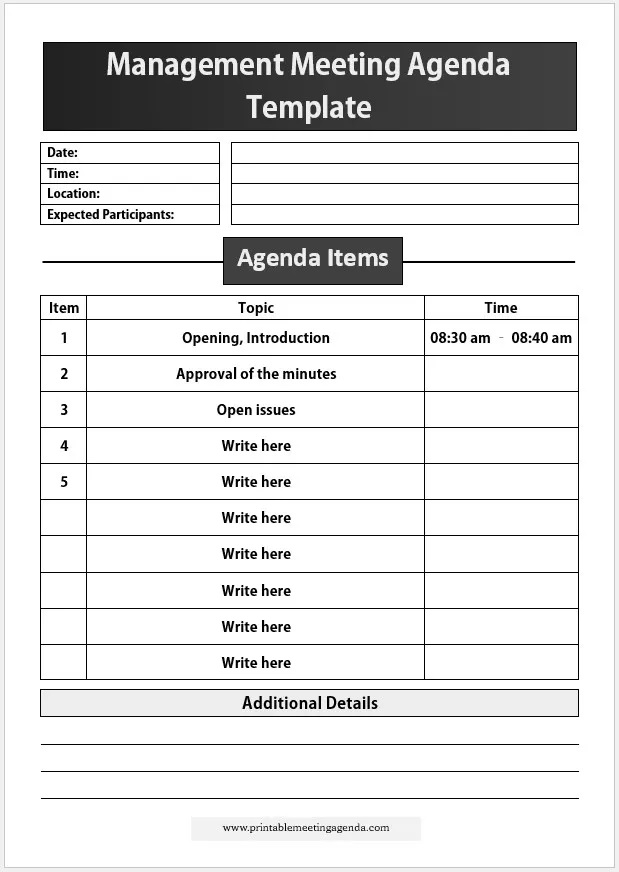
Templates for management team, senior management and executive meetings. Download them free and edit in Word or Google Docs.
property management meeting agenda template

File Type: MS Word {Zip File}
File Size: 42 KB
Printable Senior Management Meeting Agenda

File Type: MS Word {Zip File}
File Size: 18 KB

Management meeting agenda example
This is a 60-minute weekly leadership team meeting for a manufacturing company. Each item is labeled as Inform, Discuss or Decide, so everyone knows what the item needs from them, and supporting reports are sent out beforehand as pre-reads.
Crestview Manufacturing, Leadership Team
Weekly Management Meeting Agenda
Objective: Approve the December staffing plan
| Time | Item | Type |
|---|---|---|
| 8:30 | Actions from last meeting | Inform |
| 8:35 | KPI dashboard: output, sales, cash (pre-read) | Inform |
| 8:50 | Add a second shift in December? (pre-read) | Decide |
| 9:10 | Packaging supplier delays | Discuss |
| 9:20 | Key messages for staff this week | Decide |
| 9:25 | Decisions, actions and owners | Close |
Pre-reads sent Friday. Next meeting: Monday, 23 November, 8:30 AM
Notice that the biggest block of time goes to the decision, not the updates. Because the KPI dashboard was sent out on Friday, the team only needs 15 minutes to discuss what the numbers mean rather than reading them together.
Build your management agenda around decisions
The most common problem with management meetings is that they become a series of reports. Each manager presents an update, there is little time left for real problems, and the meeting ends without decisions. A decision-first agenda fixes this.
Label every item
Mark each agenda item as Inform (for awareness, usually brief), Discuss (input needed, no decision yet) or Decide (the team must agree today). If most of your items are Inform, move them to a written update.
Write items as questions
Instead of “Sales update”, write “Do we lower the Q4 sales target?”. Instead of “Hiring”, write “Which two roles do we hire first?”. A question tells everyone what the team needs to answer.
Give every item a purpose, owner, pre-read and time
For each item, note why it is on the agenda, which manager owns it, what people should read in advance, and how many minutes it gets. This simple checklist keeps discussions short and makes sure the right person comes prepared.
What to include in a management meeting agenda
- Meeting details. Date, time, location or video link, chair and attendees.
- Objective. The main decision or outcome the meeting must produce.
- Review of previous actions. A quick check of what was agreed last time and whether it was done.
- Key metrics. A short review of the numbers that matter most, such as revenue, costs, output or customer satisfaction.
- Decision items. Proposals that need approval, with the owner and pre-read listed.
- Discussion items. Problems, risks and cross-department issues that need input.
- Messages to share. What managers should tell their teams after the meeting.
- Decisions and action items. A recap of decisions, owners and deadlines, and the date of the next meeting.
Agendas for different types of management meetings
Weekly management team meeting
For department heads and managers keeping operations on track. Keep it to 45 to 60 minutes.
- Actions from last week
- Key metrics and anything off track
- Issues that need another department’s help
- One or two decisions
- Messages for teams and action items
Monthly management review
A longer meeting, usually 90 minutes, to review the month’s results and adjust plans.
- Financial results against budget
- Department performance and key projects
- Customer and quality issues
- People: hiring, turnover and training
- Risks and priorities for next month
- Decisions and action items
Senior management meeting
For the senior leaders responsible for the organization’s direction. Start by reviewing the minutes and outstanding actions from the previous meeting.
- Approval of previous minutes and action review
- Business performance and financial position
- Progress on strategic priorities
- Major decisions: investments, new markets, structure
- Risks, compliance and escalations
- Open discussion and upcoming deadlines
Executive team meeting
For the CEO and C-suite: CFO, COO, CMO, CTO and CHRO. Executive meetings are usually weekly and focus on company-wide priorities and cross-functional decisions. Many executive teams open with a consent agenda, where routine items such as last week’s minutes are approved together in one step to save time.
- Consent agenda: minutes and completed actions
- Company KPI dashboard
- Decisions on targets, budgets or major initiatives
- Cross-functional risks and escalations
- People and culture priorities
- Wrap-up: decisions, owners and next agenda
Quarterly strategic leadership meeting
A half-day or full-day session to review the quarter and adjust strategy. For more detail, see our strategic planning meeting agenda templates.
- Quarterly results against goals
- Market and competitor changes
- Deep dive on top strategic initiatives
- Talent, succession and leadership development
- Goals and priorities for next quarter
- Action plan and owners
HR management meeting
For HR managers and department heads discussing people issues.
- Headcount, hiring and turnover
- Open roles and recruitment progress
- Performance reviews and development plans
- Policy updates and compliance
- Employee engagement and wellbeing
- Action items
Management, executive and board meetings compared
| Meeting | Who attends | Main focus | Typical frequency |
|---|---|---|---|
| Management meeting | Managers and department heads | Operations, performance and day-to-day decisions | Weekly |
| Executive meeting | CEO and senior executives | Company priorities, strategy execution and major decisions | Weekly or monthly |
| Board meeting | Board of directors, with the CEO | Governance, oversight and long-term direction | Quarterly |
| All-hands meeting | All employees | Sharing news, results and recognition | Monthly or quarterly |
Tips for more effective management meetings
- Send pre-reads 48 hours ahead. Reports and proposals should be read before the meeting, not presented during it.
- Keep the attendee list small. Invite people who make or directly shape decisions. Others can read the summary.
- Put decisions early. Tackle the most important decision while everyone is fresh.
- Keep a decision log. Record every decision with the date and owner, so the team doesn’t reopen settled questions.
- Disagree, then commit. Encourage open debate in the meeting, but expect everyone to support the final decision outside it.
- Cascade the messages. Agree on what managers will tell their teams, so staff hear a consistent message.
- Record the outcomes. Use a meeting minutes template and review open actions at the start of every meeting.
Frequently asked questions
What is a management meeting?
A management meeting is a regular meeting of managers or department heads to review performance, coordinate across departments, solve problems and make decisions about how the organization is run.
What should be discussed in a management meeting?
Typical topics include key metrics and financial results, progress on priorities, decisions that need approval, problems between departments, risks, people issues and the messages managers should share with their teams.
How often should management meetings be held?
Most management teams meet weekly for 45 to 60 minutes, with a longer monthly review and a quarterly strategy session. Executive teams often follow the same weekly rhythm.
Who attends a senior management meeting?
Senior management meetings usually include the CEO or managing director and the heads of major functions such as finance, operations, sales, marketing, technology and HR. An assistant often attends to take minutes.
What is a consent agenda?
A consent agenda groups routine items, such as approving previous minutes or noting completed actions, so they can be approved together in one vote without discussion. It saves time for the items that need real debate.
What is the difference between an executive meeting and a board meeting?
An executive meeting is run by the company’s leaders to manage the business and carry out strategy. A board meeting is held by the board of directors to oversee the company, approve major decisions and hold the executives accountable.
Related meeting agenda templates
You may also need a board of directors meeting agenda, strategic planning meeting agenda, annual general meeting agenda or one-on-one meeting agenda for managers and their teams. Or browse all meeting agenda templates.
Pingback: Strategic Planning Meeting Agenda Templates + Retreat Sample
Pingback: Executive Meeting Agenda Templates for Leadership Teams