
A formal meeting follows a set procedure: it needs proper notice, a quorum, a chair, a fixed order of business, and minutes that record every motion and vote. Boards of directors, committees, councils, associations, clubs and annual general meetings are all formal meetings. Their agendas look different from an ordinary team meeting agenda because they are built around decisions that must be made correctly and recorded officially.
On this page you’ll find free formal meeting agenda templates in Microsoft Word, a sample formal agenda, the standard order of business, a glossary of formal meeting terms, a simple guide to motions and voting, and a comparison of formal and informal meetings.
Free Formal Meeting Agenda Templates
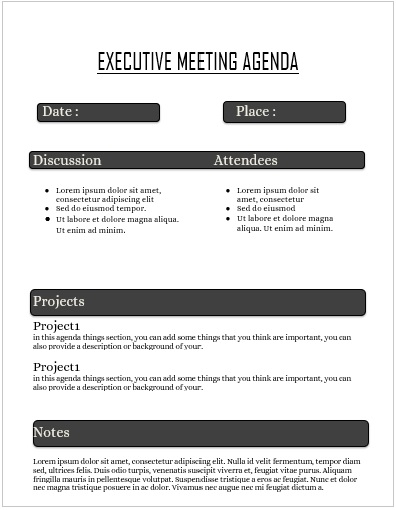
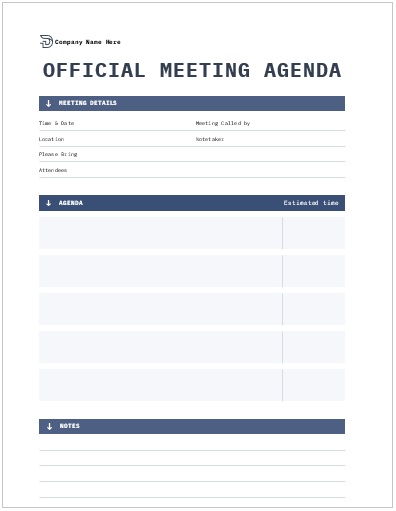
Professional, official and executive agenda formats for structured meetings. Download them free and edit in Word or Google Docs.


Formal meeting agenda example
Here is a formal agenda for the regular monthly meeting of a community arts council. Items are numbered in the standard order of business, and each one shows what action the meeting needs to take.
Riverside Arts Council
Regular Meeting Agenda
Key business: Vote on funding the summer concert series
| No. | Item | Action |
|---|---|---|
| 1 | Call to order | — |
| 2 | Roll call and quorum | Confirm |
| 3 | Approval of the agenda | Approve |
| 4 | Minutes of the meeting of 12 October | Approve |
| 5 | Reports: Chair, Treasurer, Grants Committee | Receive |
| 6 | Correspondence | Receive |
| 7 | Unfinished business: mural grant criteria | Vote |
| 8 | New business: $3,000 for summer concert series | Vote |
| 9 | Announcements | — |
| 10 | Adjournment | — |
Reports and the concert series proposal are attached to this agenda
“Receive” means the meeting formally notes a report without voting on its contents. “Vote” marks the items where a motion will be put to the members.
Formal agenda format: standard order of business
Most formal meetings follow this order, based on parliamentary procedure such as Robert’s Rules of Order. Your constitution or bylaws may set a slightly different order.
- Call to order. The chair opens the meeting and notes the time.
- Roll call and quorum. The secretary records attendance and apologies, and confirms a quorum is present.
- Declarations of interest. Members declare any personal interest in items on the agenda.
- Approval of the agenda. The meeting confirms or amends the agenda.
- Approval of previous minutes. Corrections are noted, and the minutes are approved as a true record.
- Matters arising. Follow-up on actions from the previous minutes.
- Reports. Reports from officers such as the chair and treasurer, and from committees.
- Correspondence. Letters and emails received that the meeting should know about.
- Unfinished business. Items carried over from earlier meetings.
- New business. New motions and proposals.
- Public or member comment. Time for non-members or members to speak, where allowed.
- Announcements and date of next meeting.
- Adjournment. The chair formally closes the meeting.
Formal vs. informal meetings
| Formal meeting | Informal meeting | |
|---|---|---|
| Examples | Board, committee, council, AGM, HOA, PTA | Team catch-up, brainstorm, coffee meeting |
| Notice | Written notice, often a set number of days in advance | A calendar invite or message |
| Agenda | Fixed order of business, numbered items | Short list of topics, flexible order |
| Decisions | Motions and votes, often needing a quorum | Agreement or consensus |
| Record | Official minutes, approved at the next meeting | Notes or a follow-up message |
| Rules | Bylaws, constitution or parliamentary procedure | Common sense and good manners |
For relaxed meetings, see our informal meeting agenda templates.
Formal meeting terms explained
| Term | Meaning |
|---|---|
| Quorum | The minimum number of members who must be present for decisions to be valid |
| Motion | A formal proposal for the meeting to take a specific action |
| Second | Support from another member so a motion can be discussed |
| Amendment | A proposed change to the wording of a motion |
| Resolution | A motion that has been passed and becomes a formal decision |
| Abstain | Choose not to vote for or against a motion |
| Table or postpone | Set a motion aside to be dealt with later |
| Point of order | Raising a concern that the rules are not being followed |
| Consent agenda | Routine items approved together in a single vote |
| Matters arising | Follow-up on items from the previous minutes |
| AOB | Any other business: brief items not listed elsewhere |
| Adjourn | Formally close the meeting |
How motions and voting work
- Make the motion. A member says, “I move that…” followed by the exact proposal.
- Second it. Another member says, “I second the motion.” Without a second, many meetings don’t discuss it further.
- State the motion. The chair repeats it so everyone knows exactly what is being decided.
- Discuss it. Members speak in turn, and amendments may be proposed and voted on.
- Vote. The chair asks for votes in favor, against and abstaining, usually by show of hands.
- Announce and record the result. The chair declares it carried or defeated, and the secretary records it in the minutes.
Use a meeting minutes template to record each motion, who proposed and seconded it, and the result.
Formal agendas for different organizations
Each type of formal meeting adds its own items to the standard order of business. Find detailed agendas and templates here:
| Meeting | What it adds |
|---|---|
| Board of directors meeting | Conflicts of interest, consent agenda, CEO report, executive session |
| Annual general meeting | Notice of meeting, annual accounts, elections, resolutions |
| HOA meeting | Homeowner forum, manager’s report, executive session |
| PTA meeting | Principal’s report, committee reports, officer elections |
| Safety committee meeting | Incident reports, inspection findings, recommendations |
| Executive meeting | Company scorecard, decision papers, board preparation |
Tips for chairing a formal meeting
- Know your rules. Check your bylaws or constitution for notice periods, quorum and voting rules.
- Prepare the agenda with the secretary. Confirm which items need a vote and attach reports and proposals.
- Send notice on time. Formal meetings often require written notice a set number of days in advance.
- Stay neutral. The chair guides the discussion fairly and lets members speak in turn.
- State each motion clearly. Repeat the exact wording before every vote to avoid confusion.
- Keep to the agenda. New matters should usually be added to a future agenda rather than decided on the spot.
- Close each item clearly. Say what was decided before moving on, so the minutes are accurate.
Frequently asked questions
What is a formal meeting?
A formal meeting is a meeting run according to set rules, usually those in an organization’s bylaws or constitution. It has a chair, a quorum, a fixed order of business, motions and votes, and official minutes.
What is the order of a formal meeting agenda?
A typical order is call to order, roll call and quorum, declarations of interest, approval of the agenda, approval of previous minutes, matters arising, reports, correspondence, unfinished business, new business, announcements and adjournment.
Do formal meetings have to follow Robert’s Rules of Order?
Only if your bylaws say so. Many organizations adopt Robert’s Rules or a simplified version, while others use their own procedures. Check your governing documents.
Can new items be added to a formal agenda during the meeting?
The agenda is usually approved at the start of the meeting, and minor additions may be agreed then. Important decisions generally need proper notice, so they are best placed on the next meeting’s agenda.
Who prepares a formal meeting agenda?
The chair and the secretary usually prepare the agenda together, collecting items from officers, committees and members before a deadline.
What does “receive a report” mean?
To receive a report means the meeting formally acknowledges that it has been presented. It does not mean the meeting has approved the report’s recommendations, which need a separate motion.
Related templates and guides
You may also need an informal meeting agenda, meeting minutes templates, our guide on how to write a meeting agenda, or meeting request letter templates. Or browse all meeting agenda templates.
Pingback: Community Meeting Agenda Templates: Neighborhood & Town Hall
Pingback: Medical Staff Meeting Agenda Templates: Hospital & Clinic
Pingback: Family Meeting Agenda Template + 40 Family Meeting Ideas