
A daily meeting, often called a stand-up or huddle, is a short check-in at the start of the day where a team shares what it’s working on, spots problems early and agrees on today’s priorities. Done well, it takes 10 to 15 minutes and saves hours of emails and interruptions. Done badly, it drifts into a long status report. A simple, repeatable agenda is what keeps it short and useful.
On this page you’ll find free daily meeting agenda templates in Microsoft Word, a sample 15-minute stand-up agenda, the classic stand-up questions, agendas for agile teams, morning huddles, shift handovers and remote teams, and tips to keep daily meetings from dragging on.
Free daily meeting agenda templates
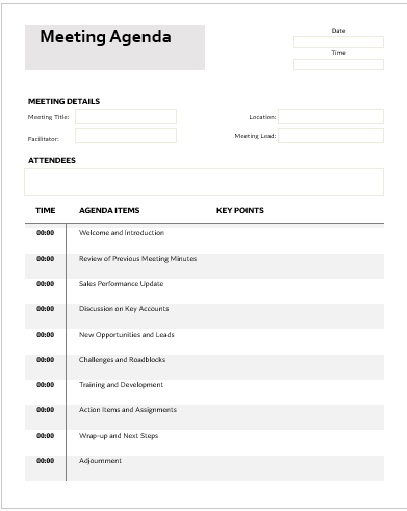
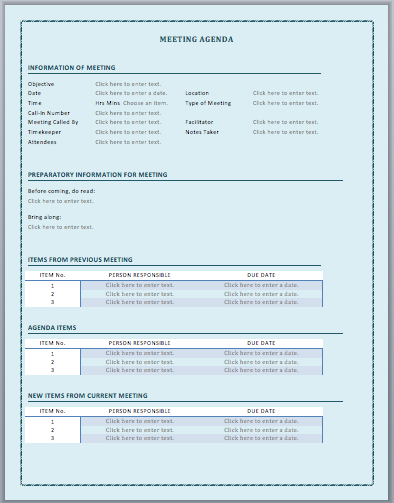
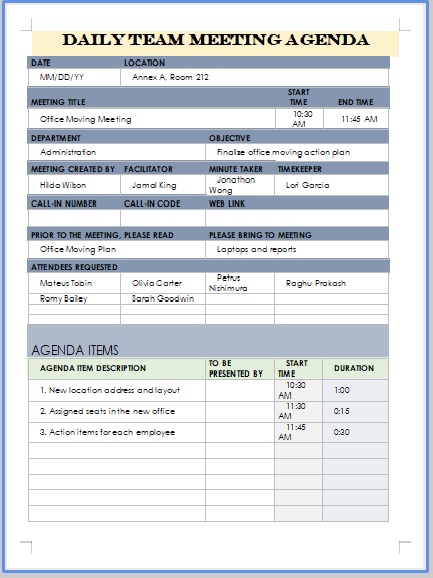
Templates for daily team meetings and daily office meetings. Download them free and edit in Word or Google Docs.

Daily stand-up meeting agenda example
Here is a 15-minute morning huddle for a customer support team. Everyone stands at the team board, speaks briefly, and any problem that needs more than a minute is handled straight afterwards with only the people involved.
Northfield Logistics, Customer Support
Daily Team Huddle
Today’s goal: Clear the weekend ticket backlog by 3 PM
| Time | Item | Who |
|---|---|---|
| 9:00 | Yesterday’s numbers: tickets and response times | Team lead |
| 9:03 | Round: done yesterday, doing today, any blockers | Everyone, 1 minute each |
| 9:11 | Today’s priorities and cover for breaks | Team lead |
| 9:13 | Shout-out and reminders | Anyone |
Blockers are discussed after the huddle with only the people involved
The key is the last line: the huddle identifies problems, but doesn’t try to solve them in front of the whole team.
The three stand-up questions
Most daily stand-ups are built around three simple questions that each person answers in about a minute:
- What did I complete yesterday?
- What will I work on today?
- Is anything blocking me?
Some teams prefer questions that focus more on the team goal, such as “What will I do today to help us reach our goal?”, “Where do I need help?” and “Is anything at risk?” Choose the version that keeps your team focused on outcomes rather than activity.
What to include in a daily meeting agenda
- A fixed time, place and length. Same time every day, usually 10 to 15 minutes.
- Today’s goal or focus. One line on what matters most today.
- Key numbers, if relevant: yesterday’s results, workload or queue.
- A quick round. Each person shares progress, plans and blockers.
- Priorities and coverage. Who is doing what, and who is covering absences.
- Parking lot. Topics to discuss after the meeting with only the people involved.
Daily meeting agendas for different teams
Agile or Scrum daily stand-up
For software and product teams working in sprints. In Scrum, this meeting is called the Daily Scrum and is limited to 15 minutes.
- Progress toward the sprint goal
- Walk the board from right to left: what is closest to done first
- Blockers and dependencies
- Adjust today’s plan
- Follow-up conversations after the stand-up
Morning office huddle
For offices, call centers, retail stores and service teams.
- Yesterday’s results and any issues
- Today’s schedule, appointments and deadlines
- Who is out and who is covering
- One focus or reminder for the day
- Quick recognition
Manager’s daily check-in
A short daily meeting for a leadership or operations team.
- Key numbers and exceptions from yesterday
- Urgent issues and decisions needed today
- Cross-team dependencies
- Messages to share with teams
Shift handover huddle
For operations, manufacturing, healthcare and hospitality teams handing over from one shift to the next. See also our nursing safety huddle and restaurant pre-shift meeting agendas.
- What happened on the last shift
- Safety issues or incidents
- Equipment or supply problems
- Priorities and targets for this shift
- Staffing and assignments
Remote or asynchronous stand-up
For distributed teams across time zones, many teams post their updates in a team chat instead of meeting live.
- Each person posts answers to the stand-up questions by a set time
- The team lead reviews updates and flags blockers
- A short live call is held only when something needs discussion
Classroom morning meeting
Many elementary school teachers start the day with a short morning meeting to build community. A common structure is:
- Greeting: every student is welcomed by name
- Sharing: a few students share news or answer a question
- Group activity: a quick game, song or challenge
- Morning message: the day’s plan and a learning prompt
Daily stand-up vs. weekly team meeting
| Daily stand-up | Weekly team meeting | |
|---|---|---|
| Length | 10–15 minutes | 30–60 minutes |
| Purpose | Coordinate today’s work and spot blockers | Review progress, plan the week and solve problems |
| Format | Standing, quick round, no slides | Seated, agenda with discussion topics |
| Problem-solving | Moved to after the meeting | Part of the meeting |
Most teams benefit from both. For the longer format, see our weekly meeting agenda templates.
Tips for better daily meetings
- Same time, same place, every day. Consistency means nobody needs an invitation.
- Actually stand up. Standing keeps meetings short.
- Timebox strictly. End at 15 minutes, even if not everything was covered.
- Don’t solve problems in the meeting. Note them and follow up afterwards with the right people.
- Use a visual board. Walking through a task board keeps updates focused on work, not people.
- Rotate the facilitator. It keeps everyone engaged and stops the meeting becoming a report to the manager.
- Start on time. Don’t wait for latecomers or repeat updates for them.
Common daily meeting mistakes
- Turning the stand-up into a status report for the manager
- Letting it run to 30 minutes or more
- Discussing detailed problems with the whole team listening
- Inviting too many people: stand-ups work best with fewer than about ten
- Updates about activity (“I had meetings”) instead of progress
Frequently asked questions
What is a daily stand-up meeting?
A daily stand-up is a short daily meeting, usually 15 minutes or less, where team members share what they did yesterday, what they will do today, and anything blocking their progress.
How long should a daily meeting be?
Ten to fifteen minutes. If it regularly runs longer, move detailed discussions to after the meeting or to a weekly meeting.
What are the three questions in a stand-up?
What did I complete yesterday? What will I work on today? Is anything blocking me?
What is the best time for a daily stand-up?
Early in the working day, once most people have arrived, often between 9:00 and 10:00 AM. For teams across time zones, choose a time that overlaps for everyone, or use an asynchronous stand-up.
What is a daily huddle?
A daily huddle is another name for a short daily team meeting, common in offices, healthcare, hospitality and retail. It covers the day’s priorities, key numbers, staffing and any urgent issues.
Should managers attend the daily stand-up?
They can, but the stand-up is for the team to coordinate with each other. Managers should listen and help remove blockers rather than turning it into a report to them.
Related meeting agenda templates
You may also need a weekly meeting agenda, team meeting agenda, project meeting agenda or informal meeting agenda. Or browse all meeting agenda templates.