
Community meetings bring neighbors, residents, local groups and sometimes public officials together to share news, raise concerns and make decisions about the place they live. They range from a small neighborhood association meeting in a library to a packed town hall with city officials. Because attendees are volunteers with different views and a limited evening, a clear agenda and a few ground rules make the difference between a productive meeting and a frustrating one.
On this page you’ll find free community meeting agenda templates in Microsoft Word, a sample neighborhood meeting agenda, agendas for town halls, public input meetings, neighborhood watch and event planning, ground rules for civil discussions, and tips for getting more people to attend.
Free community meeting agenda templates
Templates for community and neighborhood meetings, local planning meetings, community board meetings and community event planning. Download them free and edit in Word or Google Docs.
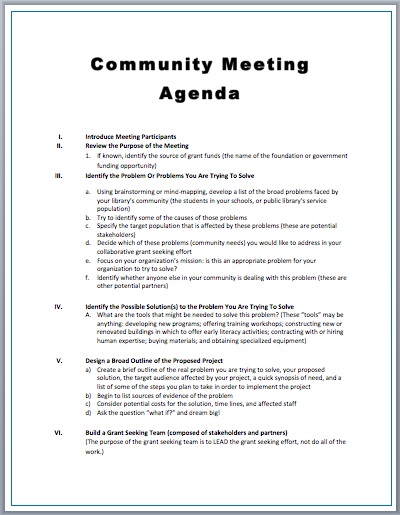
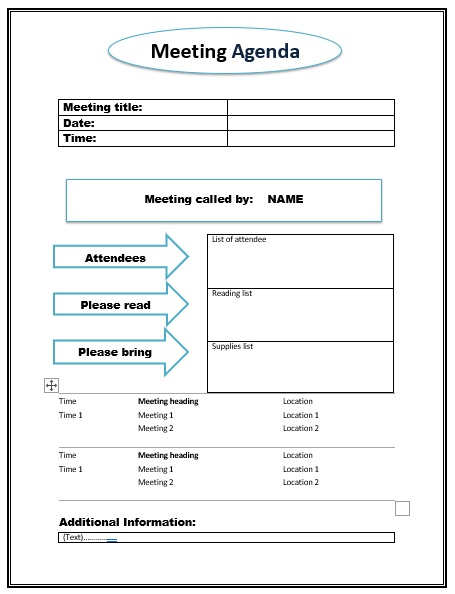
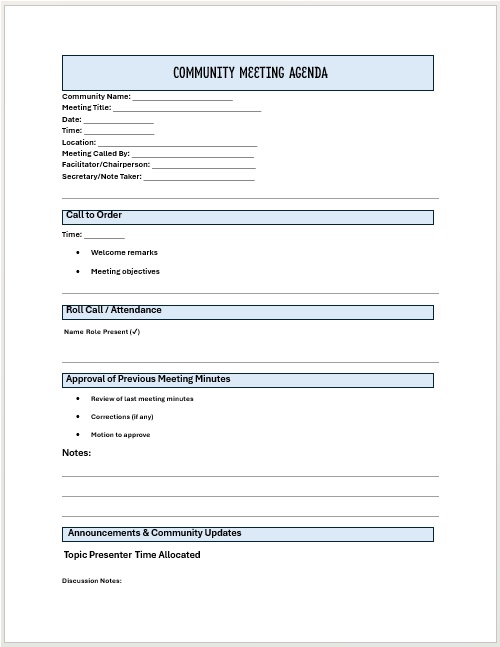
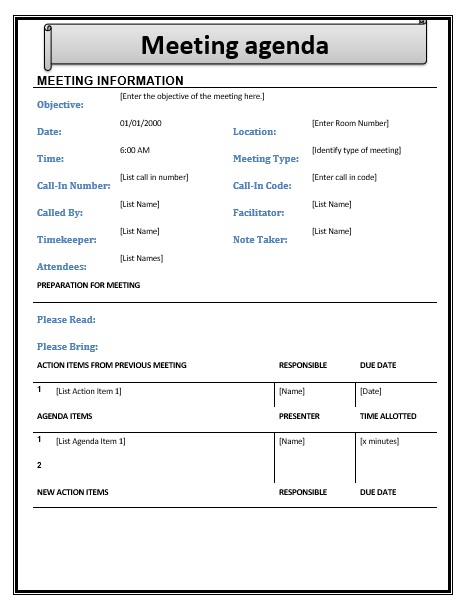
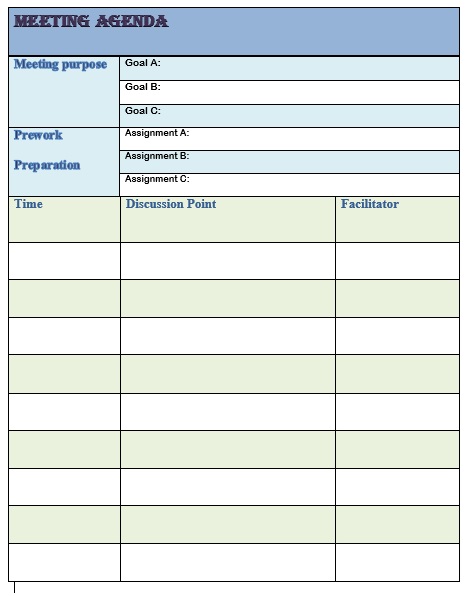
Editable Community Meeting Agenda Format
File Type: MS Word {Zip File}
File Size: 12 KB
Community meeting agenda example
Here is a 75-minute monthly meeting of a neighborhood association. It includes a guest speaker, one main issue for discussion, a community event, and a fair, timed open floor for residents.
Elmwood Neighborhood Association
Monthly Community Meeting Agenda
Main issue: Agree on a request to the city for traffic calming
| Time | Item | Lead |
|---|---|---|
| 7:00 | Welcome, introductions and ground rules | Chair |
| 7:07 | Updates on last meeting’s actions | Secretary |
| 7:15 | Neighborhood safety update | Community police officer |
| 7:30 | Main issue: traffic on Oak Street | City planner and residents |
| 7:55 | Spring clean-up day: volunteers needed | Events volunteer |
| 8:05 | Open floor (2 minutes per speaker) | Residents |
| 8:12 | Next steps and next meeting | Chair |
Refreshments from 6:45 PM · Everyone welcome
Stating the ground rules at the start, and giving the open floor a clear time limit per speaker, helps every resident get a fair chance to be heard.
What to include in a community meeting agenda
- Group name, date, time and place. Include an online link if people can join remotely, and whether the venue is accessible.
- Purpose or main issue. What the meeting is about, in plain language.
- Welcome and ground rules. How the meeting will run and how people can speak.
- Updates. Progress on actions from the last meeting and news residents should know.
- Guest speakers. Officials, police, planners or local organizations, with a set time.
- Main discussion. The issue that needs input or a decision.
- Open floor. Time for residents to raise other concerns, with a time limit per speaker.
- Next steps. Actions, volunteers, and the date of the next meeting.
Agendas for different community meetings
Neighborhood or residents’ association meeting
Regular meetings of a voluntary group of residents. If your community has a homeowners association with legal duties, see our HOA meeting agenda instead.
- Welcome and introductions of new residents
- Minutes and actions from the last meeting
- Treasurer’s update, if the group collects dues
- Committee or project updates
- Main issue for discussion
- Upcoming events and volunteers
- Open floor and close
Town hall meeting
A public meeting where elected officials or leaders share information and answer questions from residents.
- Welcome from the host and introduction of officials
- Ground rules for questions
- Opening remarks from each official (time-limited)
- Presentation on key local issues
- Questions from the audience, alternating in-person and online
- Closing remarks and how to follow up
Public input or consultation meeting
Held when a council, developer or agency wants community feedback on a plan or proposal.
- Welcome and purpose: what feedback is being sought
- Presentation of the proposal
- Clarifying questions
- Small-group discussion or comment stations
- Report back from groups
- How feedback will be used and the decision timeline
Neighborhood watch meeting
- Welcome and introductions
- Recent incidents and crime trends from the local police liaison
- Home and personal safety tips
- Communication: phone tree, group chat and reporting
- Street coordinators and volunteer roles
- Next meeting and close
Community event planning meeting
For planning a festival, clean-up, fundraiser or holiday event. See also our event agenda templates.
- Event goal, date and location
- Budget and sponsors
- Activities and schedule for the day
- Permits, insurance and safety
- Promotion
- Volunteer roles and sign-ups
- Tasks and deadlines
Community board meeting
Formal meetings of an appointed or elected community board or committee follow a stricter structure with motions and votes. See our formal meeting agenda guide for the full order of business.
Senior community meeting
For senior centers, retirement communities and groups of older residents.
- Welcome and birthdays or celebrations
- News and updates from staff or the residents’ council
- Activities and trips for the coming month
- Health, safety or services talk
- Residents’ suggestions and concerns
- Close and refreshments
Ground rules for civil community meetings
Community meetings can get heated when people care deeply about an issue. Share these ground rules at the start and ask everyone to agree to them:
- One person speaks at a time, and only when called on by the chair.
- Keep to the time limit for each speaker.
- Stay on the topic being discussed.
- Criticize ideas, not people. No personal attacks.
- Listen to understand, even when you disagree.
- Issues that can’t be resolved tonight will be noted and followed up.
If a discussion becomes tense, the chair can pause, restate the facts, summarize each side fairly, and suggest a next step such as a working group or follow-up meeting.
How to get more people to community meetings
- Pick a convenient time. Early evening on a weekday usually works best. Avoid school holidays.
- Promote in several places. Use flyers, local social media groups, newsletters, noticeboards and word of mouth.
- Lead with the issue. “Come and have your say on the Oak Street traffic plan” draws more people than “Monthly meeting”.
- Make it easy to attend. Choose an accessible venue, offer an online option, and consider childcare and interpretation.
- Add food and connection. Refreshments and time to chat make meetings feel like a community event.
- Keep it short. An hour to 75 minutes is plenty for most community meetings.
- Show results. Share what changed because of past meetings, so people know it’s worth coming.
Community meeting topic ideas
Safety
- Crime prevention and neighborhood watch
- Street lighting
- Emergency preparedness
- Safe routes to school
- Fire safety
Streets and infrastructure
- Traffic calming and speeding
- Parking
- Road and sidewalk repairs
- Public transport
- Bike lanes
Environment and spaces
- Parks and playgrounds
- Litter and clean-up days
- Community gardens
- Tree planting
- Recycling
Community life
- Festivals and block parties
- Welcoming new residents
- Support for older neighbors
- Youth activities
- Local businesses
Planning and services
- New developments and planning applications
- Local council updates
- Schools and libraries
- Health services
- Housing
After the meeting
- Share a short summary. Post key points, decisions and actions where residents will see them, using a meeting minutes template.
- Follow up with officials. Send requests or questions raised at the meeting. Our meeting request letters include a sample for writing to elected officials.
- Thank volunteers and speakers.
- Report back at the next meeting. Start with what happened since last time.
Frequently asked questions
What is a community meeting?
A community meeting is a gathering of residents, local groups and sometimes officials to share information, discuss local issues and make decisions or plans that affect the neighborhood or community.
What should be on a community meeting agenda?
A community meeting agenda usually includes a welcome and ground rules, updates on previous actions, guest speakers, a main issue for discussion, an open floor for residents, and next steps with the date of the next meeting.
How long should a community meeting be?
Most community meetings work best at 60 to 90 minutes. Town halls on big issues may run longer, but should include a clear end time.
How do you run a town hall meeting?
Introduce the officials, set clear rules for questions, keep opening remarks short, then spend most of the time on audience questions, alternating between in-person and online. Close by explaining how people can follow up.
How do you handle angry residents at a community meeting?
Acknowledge their concern, restate the ground rules calmly, give them a fair chance to speak within the time limit, and offer a specific follow-up, such as a meeting with the right official or a working group.
What is the difference between a community meeting and an HOA meeting?
An HOA meeting is a formal meeting of a homeowners association, which has legal powers and duties under its governing documents. A community meeting is usually more open and voluntary, bringing together anyone who lives or works in the area.
Related meeting agenda templates
You may also need an HOA meeting agenda, PTA meeting agenda, girls’ group meeting agenda, event agenda or formal meeting agenda. Or browse all meeting agenda templates.