
A one-on-one meeting is a regular, private conversation between a manager and an employee. Done well, it’s the most useful half hour of the week for both of you: problems get raised early, feedback flows both ways, and career goals don’t get lost in day-to-day work. A simple agenda is what keeps it from turning into another status update.
Below you’ll find free one-on-one meeting agenda templates in Microsoft Word, a sample 1:1 agenda, ready-made agendas for six common situations, and 40 questions to ask in your next one-on-one.
Free one-on-one meeting agenda templates
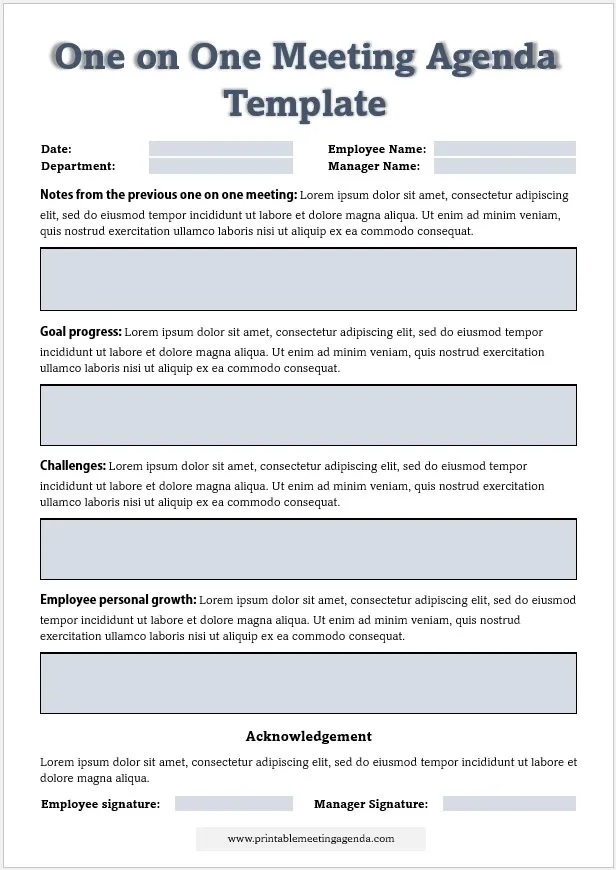
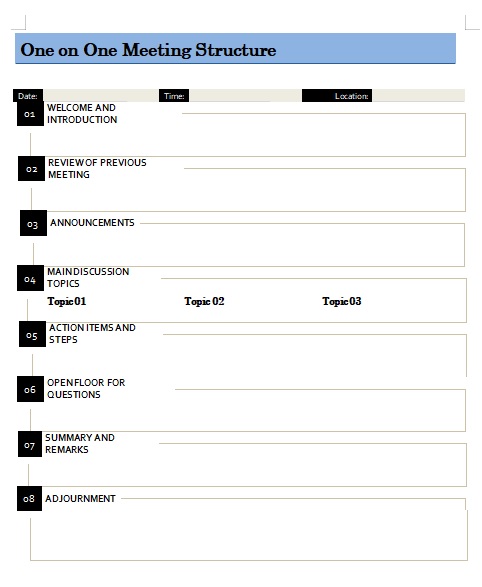
Download a template, open it in Word or Google Docs, and share it with your employee or manager before the meeting so both of you can add topics.


One-on-one meeting agenda example
This is a typical 30-minute weekly 1:1 between a manager and a team member. The employee’s topics come first, because a one-on-one is mainly their meeting, not the manager’s.
Weekly 1:1
Alex Chen and Maria Lopez
Focus this week: Workload before the Q4 launch
| Time | Item | Lead |
|---|---|---|
| 11:00 | Check-in: how are things going? | Maria |
| 11:05 | Alex’s topics and questions | Alex |
| 11:15 | Priorities, progress and blockers | Both |
| 11:20 | Feedback in both directions | Both |
| 11:25 | Action items for next week | Both |
Next 1:1: Tuesday, 27 October, 11:00 AM
Keep a running agenda in one shared document and add each week’s notes below the last. Over a few months it becomes a useful record of goals, feedback and progress, which makes performance reviews far easier to write.
What to include in a one-on-one meeting agenda
- Check-in. A few minutes on how the person is doing, at work and in general.
- Employee’s topics. Questions, concerns or ideas the employee wants to raise.
- Progress on priorities. A short look at goals and current work, not a full status report.
- Blockers and support. What is slowing them down and what help they need.
- Feedback. Specific feedback from the manager, and feedback for the manager.
- Growth and career. Skills, learning and longer-term goals, at least once a month.
- Action items. What each person will do before the next one-on-one.
One-on-one agendas for different situations
Not every 1:1 has the same purpose. Use these agenda outlines for the most common types of one-on-one meetings.
Weekly check-in
The standard 1:1 for staying in sync and catching problems early. Keep it to 30 minutes.
- How are you doing this week?
- Your topics and questions
- Top priorities and any blockers
- Quick feedback
- Action items
First one-on-one with a new manager or employee
Use the first meeting to get to know each other and agree on how you will work together.
- Background, experience and what you enjoy most about your work
- How you prefer to communicate and receive feedback
- Expectations for the role in the first 30, 60 and 90 days
- How often to meet and what these meetings should cover
- Questions from both sides
Career development
Hold a career-focused 1:1 at least once a quarter, separate from day-to-day work.
- Where the employee wants to be in one to three years
- Skills they want to build and strengths they want to use more
- Training, projects or mentors that could help
- Manager’s view of their growth so far
- Next steps before the next career conversation
Performance and feedback
For discussing results, recognizing good work and agreeing on improvements.
- Results against goals or key metrics
- What went well and should continue
- One or two areas to improve, with examples
- Support or resources needed
- An agreed plan with dates to check progress
Problem-solving
When a specific issue needs attention, such as a difficult project, a conflict or a heavy workload.
- Describe the problem and its impact
- What has been tried so far
- Possible solutions and the pros and cons of each
- Agree on a solution and who does what
- When to check whether it worked
Skip-level one-on-one
A meeting between an employee and their manager’s manager, usually every one to three months.
- What is working well on the team
- What gets in the way of doing great work
- Ideas for improving the team or company
- Questions about company direction and strategy
- Anything the employee would like leadership to know
40 one-on-one meeting questions to ask
Good questions turn a 1:1 into a real conversation. Pick two or three for each meeting rather than working through a list.
Checking in
- How are you feeling about work this week?
- What’s on your mind right now?
- What was the best part of your week?
- What was the most frustrating part?
- How is your workload, on a scale of 1 to 10?
- Is anything outside work affecting you that I should know about?
- What are you most looking forward to this month?
- Is there anything you’d like to talk about first?
Priorities and progress
- What are your top priorities this week?
- Which goal are you most and least confident about?
- Is anything taking longer than you expected?
- Are you working on anything that doesn’t feel important?
- What would you do differently on your last project?
- What decision do you need from me?
- Do you have the information you need to do your job?
- What should we stop doing as a team?
Blockers and support
- What’s getting in your way right now?
- How can I help you this week?
- Who else could help you with this?
- Are there any meetings you could skip?
- Do you have the tools and resources you need?
- Is anything unclear about what’s expected of you?
- How well is the team working together?
- Is there a problem I might not know about?
Feedback for the manager
- What could I do to support you better?
- What’s one thing I should start or stop doing?
- Am I giving you enough feedback?
- Do you feel you have enough say in decisions?
- How useful are these one-on-ones for you?
- Is there anything I’ve done recently that didn’t help?
- How clear are the team’s goals to you?
- What would make your job easier?
Growth and career
- Where would you like to be in two years?
- What skills would you like to develop?
- What kind of work gives you the most energy?
- Is there a project you would love to work on?
- Would a mentor or training course help you?
- What part of your role would you like to grow?
- What recognition matters most to you?
- What would make you want to stay here long-term?
How to run a great one-on-one meeting
Tips for managers
- Protect the time. Move a 1:1 if you must, but avoid cancelling it, since cancellations tell people they are a low priority.
- Listen more than you talk. Aim for the employee to speak most of the time.
- Keep status updates out of the meeting where possible. Use a written update or the team meeting instead.
- Write down action items and follow up on your own promises first.
- Save serious concerns for a private, focused conversation rather than raising them at the end of a routine check-in.
Tips for employees
- Add your topics to the shared agenda a day before the meeting.
- Bring problems with a possible solution, even if it isn’t perfect.
- Ask for specific feedback, such as “What could I have done better in that client presentation?”
- Use the time to talk about your goals and growth, not only your current tasks.
- Keep notes so you can track progress and refer back to earlier conversations.
How often should you have one-on-one meetings?
| Frequency | Length | Best for |
|---|---|---|
| Weekly | 30 minutes | New employees, fast-moving work and most teams |
| Every two weeks | 30–45 minutes | Experienced, independent team members |
| Monthly | 45–60 minutes | Senior staff and career-focused conversations |
| Every 1–3 months | 30 minutes | Skip-level meetings with a manager’s manager |
Frequently asked questions
What is a one-on-one meeting?
A one-on-one meeting is a recurring private meeting between two people, usually a manager and a direct report. It is used to discuss priorities, problems, feedback and career growth, and it gives the employee dedicated time with their manager.
Who should set the one-on-one agenda?
Both people should add to it, but the employee’s topics should come first. Many teams use a shared document where either person can add items during the week.
How long should a one-on-one meeting be?
Thirty minutes is enough for a weekly 1:1. Monthly or career-focused one-on-ones can run 45 to 60 minutes.
What is the difference between a one-on-one and a performance review?
A performance review is a formal assessment held once or twice a year. One-on-ones are regular, informal conversations. Regular 1:1s mean there should be no surprises when the performance review comes.
What should you not do in a one-on-one?
Avoid spending the whole meeting on status updates, checking your phone or email, cancelling at the last minute, or raising serious criticism without warning. The meeting should feel useful and safe for the employee.
How do I prepare for a one-on-one with my manager?
Add two or three topics to the agenda in advance, note any blockers where you need help, and think of one question about your growth or goals. Bring notes from your last 1:1 so you can follow up on action items.
Related meeting agenda templates
You may also need a team meeting agenda, management meeting agenda, training agenda or meeting minutes templates to record decisions. Or browse all meeting agenda templates.