
A training agenda is the plan for a training session, workshop or program. It tells participants what they will learn, how the time will be used, and what they need to bring, and it helps the trainer balance explanation, practice and breaks so people actually remember what they learn. Good training agendas are built around learning objectives, not just a list of topics.
On this page you’ll find free training agenda templates in Microsoft Word, a sample one-day training schedule, agendas for workshops, new employee onboarding, virtual training and multi-day programs, a guide to choosing training methods, and tips to keep learners engaged.
Free Training Agenda Templates
Templates for training sessions, training programs, team training and training meetings. Download them free and edit in Word or Google Docs.
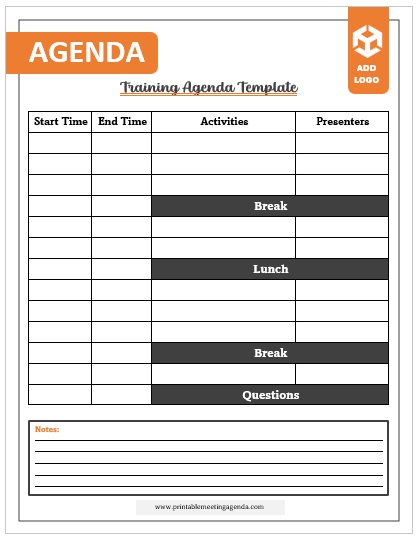


One-day training agenda example
Customer Service Excellence Training
Trainer: Olivia Grant · 16 participants · Training Room 2 · 9:00 AM – 4:30 PM
By the end of the day, participants will be able to:
- Use active listening to understand customer needs
- Stay calm and professional with difficult customers
- Resolve common complaints using a four-step method
| Time | Session | Method |
|---|---|---|
| 8:45 AM | Arrival and coffee | — |
| 9:00 AM | Welcome, objectives and icebreaker | Group discussion |
| 9:30 AM | Module 1: What great service looks like | Presentation and video |
| 10:30 AM | Break | — |
| 10:45 AM | Module 2: Active listening | Demonstration and pair practice |
| 12:00 PM | Lunch | — |
| 12:45 PM | Energizer activity | Group game |
| 1:00 PM | Module 3: Handling difficult customers | Role-play in threes |
| 2:30 PM | Break | — |
| 2:45 PM | Module 4: Resolving complaints | Case studies in small groups |
| 3:45 PM | Personal action plans | Individual reflection |
| 4:15 PM | Quick quiz, evaluation and close | Quiz and feedback form |
Notice how each module uses a different method, and the most active one, role-play, comes straight after lunch when energy is usually lowest.
What to include in a training agenda
- Training title. A clear name that says what the training is about.
- Learning objectives. Two to five things participants will be able to do by the end.
- Audience and prerequisites. Who the training is for and any prior knowledge or pre-work needed.
- Trainer, date, time and venue. Including the video link for online sessions.
- Sessions or modules. Each with a start time, title and training method.
- Breaks and meals. At least every 90 minutes.
- Materials. What participants should bring, and what will be provided.
- Assessment and evaluation. Quizzes, practical tasks or feedback forms.
- Follow-up. Resources, refresher sessions or support after the training.
How to build a training agenda
- Know your audience. Find out what participants already know and what they need to do differently.
- Write the learning objectives. Use action verbs, such as “handle”, “use” or “complete”, rather than “understand”.
- Choose only essential content. Cover what’s needed to meet the objectives, and leave the rest for handouts.
- Put it in a logical order. Move from simple to complex, and from explanation to practice.
- Vary the methods. Switch activity every 15 to 20 minutes where possible.
- Plan for practice. Aim to spend at least half the time on activities, not presentations.
- Add breaks and energizers. Especially after lunch and in long sessions.
- End with application. Finish with action plans, a summary and an evaluation.
Choosing training methods
| Method | Best for | Typical time |
|---|---|---|
| Short presentation | Introducing new ideas and facts | 10–20 minutes |
| Demonstration | Showing a skill or process step by step | 10–15 minutes |
| Group discussion | Sharing experience and exploring questions | 15–30 minutes |
| Pair or small-group practice | Practicing a skill with feedback | 20–45 minutes |
| Role-play | Practicing conversations and soft skills | 30–60 minutes |
| Case study | Applying knowledge to realistic situations | 30–60 minutes |
| Quiz | Checking understanding and reinforcing learning | 5–15 minutes |
| Reflection and action planning | Turning learning into next steps | 10–20 minutes |
Training agendas for different formats
Half-day workshop agenda
Workshops are hands-on sessions where participants practice a skill, usually in a small group. For talk-based sessions, see our seminar agenda templates and our article on seminar vs. workshop agendas.
- Welcome, objectives and introductions (15 minutes)
- Short input on the first skill (15 minutes)
- Practice in pairs or small groups (40 minutes)
- Break (15 minutes)
- Short input on the second skill (15 minutes)
- Group exercise or case study (45 minutes)
- Share results and feedback (20 minutes)
- Action plans, evaluation and close (15 minutes)
New employee onboarding agenda (first day)
- Welcome and introduction to the team
- Company mission, values and structure
- Tour of the workplace, including safety and emergency exits
- HR paperwork, policies and benefits
- IT setup: equipment, accounts and tools
- Lunch with the team or a buddy
- Role expectations and first-week goals with the manager
- Questions and plan for the rest of the week
A first-week one-on-one meeting with the new employee’s manager helps set clear expectations early.
Virtual training session agenda
- Technical check and welcome (5 minutes)
- Objectives and how to use chat, polls and breakout rooms (5 minutes)
- Short presentation (15 minutes)
- Poll or quick exercise (10 minutes)
- Breakout room practice (20 minutes)
- Report back and Q&A (15 minutes)
- Summary, resources and evaluation link (5 minutes)
Multi-day training program
- Day 1: Welcome, objectives, core concepts and first practice
- Day 2: Recap, advanced skills, case studies and group projects
- Day 3: Recap, applying skills to real work, assessment, action plans and certificates
Start each day with a short recap and end with a summary of what’s coming next.
Safety training session
Workplace safety training often follows a “tell, show, do, review” pattern: explain the hazard and procedure, demonstrate it, have each person practice, then check understanding and record attendance. For short on-the-job briefings, see our safety meeting agenda templates.
Tips for engaging training sessions
- Break every 90 minutes. Attention and memory drop sharply in long, unbroken sessions.
- Keep presentations short. Aim for no more than 20 minutes of talking before an activity.
- Use real examples. Case studies and scenarios from participants’ own work make training stick.
- Get people moving after lunch. Use active exercises when energy is low.
- Send pre-work. A short reading or video before the session saves time for practice.
- Make it accessible. Provide materials in advance and check for any accessibility needs.
- Evaluate and follow up. Ask for feedback at the end, and check a few weeks later whether people are using what they learned.
Frequently asked questions
What is a training agenda?
A training agenda is a schedule for a training session or program. It lists the learning objectives, sessions or modules with their times and methods, breaks, materials and how learning will be evaluated.
How long should a training session be?
Short training sessions work well at 60 to 90 minutes. Half-day workshops run about three to four hours, and full-day training usually runs six to seven hours with regular breaks.
What is the difference between training, a workshop and a seminar?
Training is the broad term for teaching people new skills or knowledge. A workshop is a hands-on training format with practice and group work. A seminar focuses more on talks, discussion and Q&A.
What should be on a new employee onboarding agenda?
A first-day onboarding agenda usually includes a welcome and team introductions, company values, a workplace tour, HR paperwork and policies, IT setup, lunch with the team, and a meeting with the manager about role expectations.
How do you keep virtual training engaging?
Keep sessions shorter than in person, use polls, chat and breakout rooms often, switch activities every 10 to 15 minutes, and ask people to keep cameras on where possible.
How do you evaluate training?
Common approaches look at four levels: how participants felt about the training, what they learned, whether they changed their behavior at work, and what results followed. Feedback forms and quizzes cover the first two; follow-up with managers covers the others.
Related agenda templates
You may also need a seminar agenda, conference agenda, retreat agenda, staff meeting agenda or safety meeting agenda. Or browse all meeting agenda templates.