
A homeowners association (HOA) meeting is where the board makes decisions about the community’s money, property and rules, and where homeowners can see those decisions being made and have their say. Because HOA meetings are formal, often governed by state law and the association’s bylaws, a clear agenda matters more here than in almost any other meeting.
On this page you’ll find free HOA meeting agenda templates in Microsoft Word for board meetings and annual meetings, a sample HOA board meeting agenda, the standard order of business, outlines for annual, special and executive session meetings, and answers to common questions about HOA meetings.
Free HOA meeting agenda templates
Templates for regular HOA board meetings and annual homeowner meetings. Download them free, add your association’s details, and post or send the agenda to homeowners before the meeting.


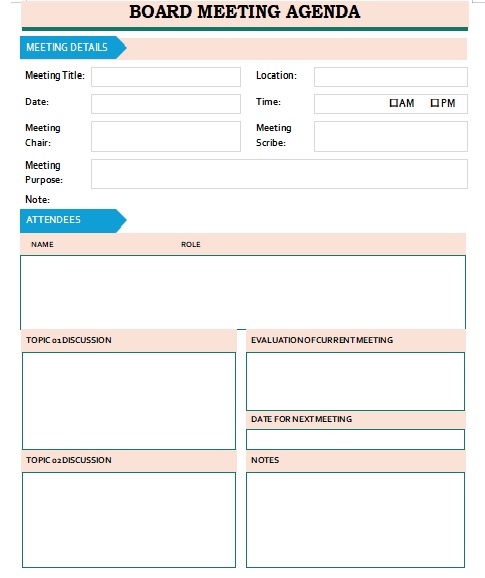
HOA board meeting agenda example
Here is a sample agenda for a regular monthly HOA board meeting. It follows the standard order of business, gives homeowners a set time to speak, and keeps confidential matters for a separate closed session afterwards.
Maple Ridge Homeowners Association
Regular Board Meeting Agenda
Main item: Review the draft 2027 budget
| Time | Item | Lead |
|---|---|---|
| 7:00 | Call to order and quorum | President |
| 7:02 | Approval of agenda | Board |
| 7:05 | Homeowner forum (3 minutes each) | Homeowners |
| 7:20 | Approval of October minutes | Secretary |
| 7:25 | Treasurer’s report | Treasurer |
| 7:35 | Manager’s report | Manager |
| 7:45 | Old business: pool resurfacing bids | Board |
| 7:55 | New business: draft 2027 budget | Treasurer |
| 8:10 | Next meeting date and adjournment | President |
Executive session to follow (closed): delinquent accounts
Many boards hold the homeowner forum near the start, so residents don’t have to wait through the whole meeting to speak. Others place it just before adjournment. Either is fine as long as it is clearly listed on the agenda.
Standard order of business for an HOA meeting
Most HOA meetings follow this order, which is based on common parliamentary procedure such as Robert’s Rules of Order:
- Call to order. The president opens the meeting and notes the time.
- Roll call and quorum. Confirm that enough board members (or homeowners, for an annual meeting) are present. Without a quorum, the meeting cannot make official decisions.
- Approval of the agenda. The board confirms the agenda, including any changes.
- Approval of previous minutes. Corrections are noted and the minutes are approved by vote.
- Officer reports. Usually the president’s and treasurer’s reports, including the financial statements.
- Manager and committee reports. Updates from the property manager and committees such as architecture, landscaping or social events.
- Homeowner forum. Time for homeowners to ask questions or raise concerns.
- Old business. Items carried over from previous meetings that still need discussion or a vote.
- New business. New proposals, contracts, projects or rule changes.
- Next meeting and adjournment. Confirm the date of the next meeting and formally close.
Types of HOA meetings
| Meeting | Who attends | Purpose | How often |
|---|---|---|---|
| Board meeting | Board members; homeowners may usually observe | Regular business: finances, maintenance, contracts, rules | Monthly or quarterly |
| Annual meeting | All homeowners (members) | Elect directors, present the budget and year in review | Once a year |
| Special meeting | Board or members, depending on the issue | One urgent or specific topic, such as a special assessment | As needed |
| Executive session | Board members only | Confidential matters such as legal issues and delinquencies | Before or after board meetings |
| Committee meeting | Committee members | Detailed work that is reported back to the board | As needed |
HOA annual meeting agenda
The annual meeting is the main meeting for all homeowners. It usually includes the election of board members and a review of the year.
- Call to order and welcome
- Proof of notice and confirmation of quorum
- Approval of last year’s annual meeting minutes
- President’s report on the year
- Treasurer’s report and presentation of the budget
- Committee reports
- Election of directors: candidate introductions, voting and results
- Homeowner questions and open forum
- Adjournment
HOA special meeting agenda
A special meeting is called to deal with one specific issue. Only the topics listed in the meeting notice can be discussed and decided.
- Call to order and quorum
- Reading of the meeting notice and purpose
- Presentation of the issue
- Homeowner questions and comments
- Board discussion and vote
- Adjournment
HOA executive session agenda
Executive sessions are closed to homeowners and are used only for confidential matters. The general topic, but not the private details, is usually noted on the open meeting agenda.
- Call to order
- Legal matters and advice from the association’s attorney
- Contract negotiations
- Delinquent assessments and payment plans
- Rule violation hearings
- Personnel matters
- Adjournment, with decisions reported in the next open meeting where required
HOA meeting notice and legal requirements
HOA meetings are usually governed by state law and by the association’s own governing documents, such as the bylaws and CC&Rs. The rules often cover how much notice homeowners must receive, whether the agenda must be posted, when homeowners can speak, and what can be discussed in a closed session.
The details vary a lot from state to state. For example, California generally requires board meeting notice and the agenda to be given at least four days in advance, while Florida generally requires notice of HOA board meetings to be posted at least 48 hours ahead. Longer notice periods usually apply to annual meetings and to meetings where assessments will be decided.
Always check your state’s HOA laws and your association’s bylaws, or ask your property manager or the association’s attorney, before setting your meeting schedule. This page is general information, not legal advice.
Common HOA meeting agenda items
Finances
- Monthly financial statements
- Annual budget approval
- Reserve fund and reserve study
- Delinquent dues and collections
- Special assessments
- Insurance renewal
Property and maintenance
- Landscaping and snow removal contracts
- Pool, clubhouse and amenity repairs
- Roof, paving and exterior projects
- Vendor bids and approvals
- Security, lighting and gates
- Architectural change requests
Rules and governance
- Rule and policy changes
- Violations and fines
- Parking and pet policies
- Short-term rental rules
- Bylaw amendments
- Board elections and vacancies
Community
- Homeowner complaints and suggestions
- Newsletter and website updates
- Community events and volunteers
- Welcome process for new residents
- Neighborhood safety concerns
- Committee appointments
Tips for running productive HOA meetings
- Send the agenda and board packet early. Give board members the financials, bids and proposals several days ahead so they arrive ready to vote.
- Stick to the posted agenda. Many associations can only take action on items listed on the agenda, so add new topics to a future meeting instead.
- Set clear rules for the homeowner forum. A time limit per speaker, often two or three minutes, keeps the forum fair and on schedule.
- Use simple motions and votes. A motion, a second, discussion, then a vote. Record the result for every decision.
- Keep discussions respectful. The president should keep the meeting on topic and stop personal disputes politely but firmly.
- Keep accurate minutes. Record motions, votes and decisions, not every comment. Our meeting minutes templates can help.
- Share the minutes with homeowners. Publishing approved minutes builds trust in the board.
Frequently asked questions
What is a quorum at an HOA meeting?
A quorum is the minimum number of board members, or homeowners at a members’ meeting, who must be present for the meeting to make official decisions. The number is set in the association’s bylaws and sometimes by state law.
Can homeowners attend HOA board meetings?
In many states, homeowners have the right to attend and observe HOA board meetings, except for closed executive sessions. Check your state’s laws and your association’s bylaws for the exact rules.
Can homeowners speak at HOA board meetings?
Most associations include a homeowner forum where residents can speak, usually with a time limit. Some states require boards to give homeowners the opportunity to speak at open meetings.
What is an HOA executive session?
An executive session is a closed board meeting for confidential matters such as legal advice, contract negotiations, delinquent accounts, violation hearings and personnel issues. Homeowners cannot attend, but the general topics are often noted on the open meeting agenda.
How often should an HOA board meet?
Most HOA boards meet monthly or quarterly, depending on the size of the community and what the bylaws require. Every association also holds an annual meeting of all homeowners.
Who prepares the HOA meeting agenda?
The board president usually prepares the agenda, often with the secretary or the community’s property manager. Board members and homeowners can typically ask for items to be added before the agenda is finalized.
Related meeting agenda templates
You may also need a board of directors meeting agenda, annual general meeting agenda, community meeting agenda, formal meeting agenda or real estate meeting agenda. Or browse all meeting agenda templates.
Pingback: Board of Directors Meeting Agenda Templates + Sample (Free)
Pingback: Annual General Meeting (AGM) Agenda Template + Sample (Free)
Pingback: Real Estate Team Meeting Agenda Templates + 30 Meeting Ideas